
Moab Criminal History Checks
Begin a Moab records check with the event, not just a name. Moab Police keeps reports for calls its officers handled, Grand County Jail creates the Moab booking file, and a court clerk keeps the filed case. Utah does not offer a public name search of another person’s statewide rap sheet. The Bureau of Criminal Identification, or BCI, instead provides a fingerprint-supported Right of Access process for a person reviewing their own Utah record. Public Moab case research belongs in Utah Courts Xchange.
- Confirm the agency and incident number. A Moab address does not show whether city police, the sheriff, Utah Highway Patrol, or National Park Service handled the event.
- Use the Moab Police Records Request form for a Moab police report. State a date range, report number if known, and the exact record wanted.
- Check the Grand County Jail Inmate List or call the jail for current custody after a Moab arrest.
- Search Xchange for a filed Moab case, then ask the correct court clerk for an official or certified disposition.
- For a complete Moab self-review of submitted Utah arrests and outcomes, use BCI Right of Access with fingerprints and approved identification.
The broader county channels are summarized in the Grand County criminal history overview. Keep the sources separate when matching names, because a booking allegation can change before filing and a filed count can later be dismissed or amended.
Moab Police Report Requests
Moab has a direct city request route. The Moab form asks for the requester’s name, date, address, phone, email, a description of the report, and a signed access basis. Restricted Moab records may require the requester to show that they are the subject, an authorized representative, or the person who supplied the information. The form also has a five-working-day expedited choice, but the requester must explain how prompt release benefits the public. That is a statutory route, not an automatic rush service.
The official Moab Police Department page identifies the local office and its records path.
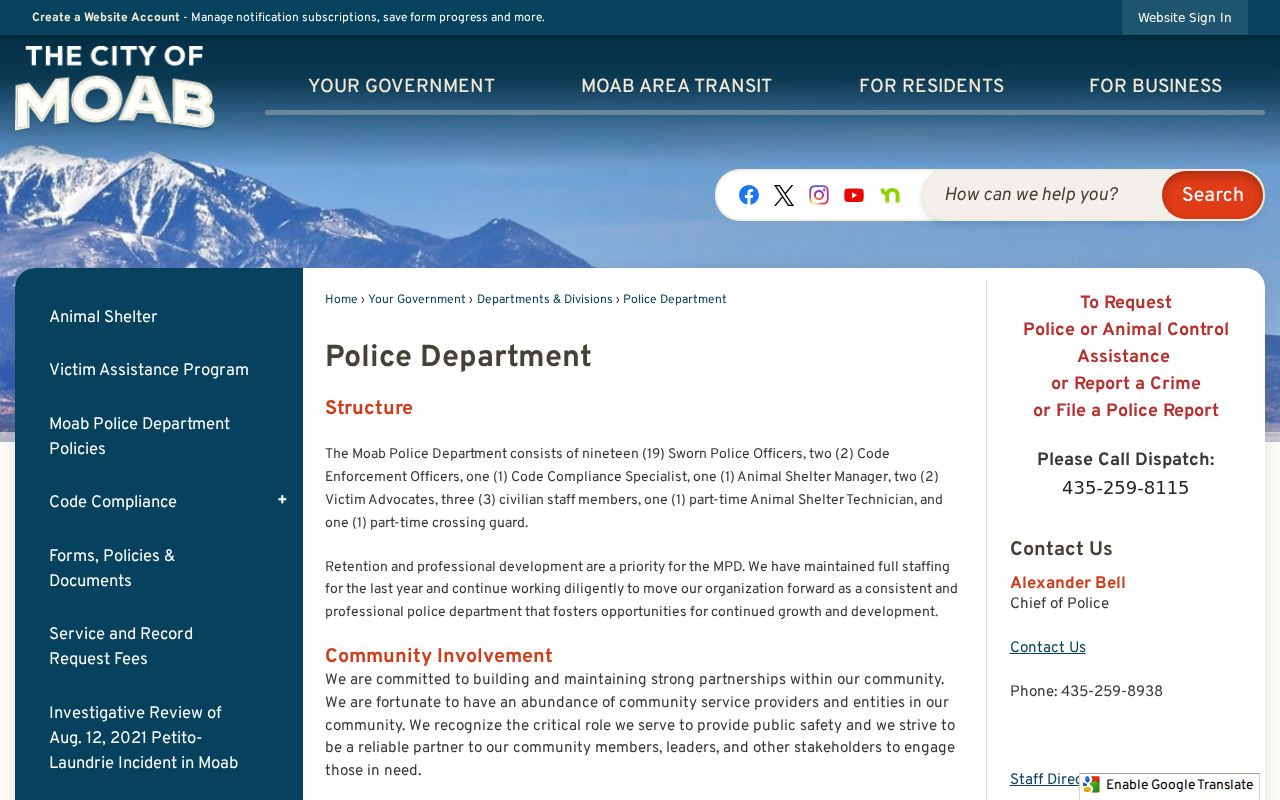
The captured department page anchors a Moab request to the Moab office rather than to a generic county search. Reports tied to a pending prosecution may need to come through discovery instead of GRAMA, and victim, juvenile, medical, identifying, or active-investigation material can be withheld or redacted.
Records at the Moab Police Department
Moab is Grand County’s only incorporated city with its own police department. The official profile reports 19 sworn officers plus code enforcement, victim advocates, civilian staff, animal shelter staff, and a crossing guard. Police offices are at 217 E. Center Street, Suite 130. Call 435-259-8938 for the office. Calls for police help, crime reports, and animal-control assistance route through dispatch at 435-259-8115.
The Moab office record is an incident or police report, not the same file as a jail booking or court docket. Ask which agency took the Moab call before paying or sending identification. No verified Moab police app, online arrest blotter, or city case-search portal was found. The official web page and city form remain the documented access channels, with the county jail and Xchange used only for the records those custodians hold.
The Moab City Hall directory shows the city’s departmental contact setting.
That city directory helps distinguish the police office from nearby county and court counters in downtown Moab.
Pending Moab Police Records
A Moab GRAMA request and criminal discovery serve different roles. Moab’s form supplies a public-record route, but it does not override limits on an active Moab case. When an unresolved report is tied to charges, an unrepresented defendant is directed to the prosecuting office for discovery. A represented defendant works through counsel. That process lets the parties obtain case material under court rules without treating a pending police file as an ordinary public copy request.
For self-review after the case ends, ask Moab Police about the report, check the filed counts and final disposition in the court record, and compare those results with any BCI entry. Each custodian corrects its own data. Moab cannot amend a court docket, and the clerk cannot rewrite the police narrative. A precise correction request should identify the disputed field, the correct source document, and the office that maintains the error.
Note: A closed court case may still leave an agency file, while expungement follows Utah’s separate statutory process for government records.
Who Created the Moab Record?
A Moab location alone can mislead a requester. Moab Police handles city incidents, while Grand County Sheriff serves county jurisdiction and manages the jail. Utah Highway Patrol handles state-road enforcement. National Park Service officers may create federal records for incidents in Arches or Canyonlands. A person may use “Moab” as a mailing address even when the event occurred outside Moab police jurisdiction.
Ask for the Moab officer’s agency and incident number at the start. A Moab police report goes to Moab’s form. A sheriff report uses the county sheriff form. A state highway record starts with Utah DPS, while a federal park matter may require the responsible federal agency and, if charged, the federal court system. This one Moab check often saves the most time.
Dispatch and the police office use different numbers, even though dispatch receives calls that may result in a Moab police report.
Booking and Arrest Records in Moab
Moab does not operate an identified long-term city jail. Moab arrestees enter the Grand County Jail booking system, where jail staff create a separate custody file, take fingerprints and a photograph, inventory property, record intake charges, and process bond, holds, release, or transfer. The official Jail Inmate List is a current Moab custody tool. A person may disappear from it after release or transfer even though the arrest and agency report still exist.
For a recent arrival, check the list and call the 24-hour jail line at 435-259-8115 if the page is unclear. For the incident narrative, return to Moab Police. For charges actually filed, search Xchange after the prosecutor and clerk have acted. A full explanation of the custody channels appears in the Grand County arrest search.
Moab Criminal Record Fees
Moab’s retrieved municipal schedule gives concrete starting rates, though fees should be confirmed before payment. The base GRAMA or records request is $30. Case photos are $2 each with a $10 minimum, plus a USB charge where one is needed. Digital photos are $20 plus USB. Audio or video work is listed at $40 per hour with a one-hour minimum, again with USB added when applicable.
| Moab record item | Published charge |
|---|---|
| GRAMA or records request | $30 base fee |
| Case photographs | $2 each, $10 minimum, plus USB if used |
| Digital photographs | $20 plus USB |
| Audio or video work | $40 per hour, one-hour minimum, plus USB |
Ask for a Moab estimate when media review or redaction may add labor. The Moab schedule does not set the sheriff’s charges, so the Moab rates should never be copied onto a county request.
The Moab Municipal Court File
No independent Moab municipal case-search portal was identified. Moab court routing turns on the charge and prosecuting authority. Seventh District Court at 125 E. Center Street hears felonies and class A misdemeanors. The official Grand County Justice Court page describes lower county cases outside Moab, so a lower Moab matter should be confirmed with the applicable prosecutor or court instead of being assumed to sit in the county Justice Court.
| Court Name | Confirm the applicable Moab prosecutor and court; felony and class A cases use Seventh District Court |
|---|---|
| Case Types Heard | Routing depends on charge level, ordinance or state basis, and prosecuting authority |
| Case Lookup Channel | Utah Courts Xchange, followed by the correct clerk for an official copy |
| What the Docket Shows | Case number, filed counts, events, hearings, orders, plea, disposition, sentence, and finances when public |
| Copies & Fees | Xchange documents may cost $1; ask the clerk about certified-copy charges |
The Grand County criminal prosecution divisions show how charge levels and geography affect the filing path.
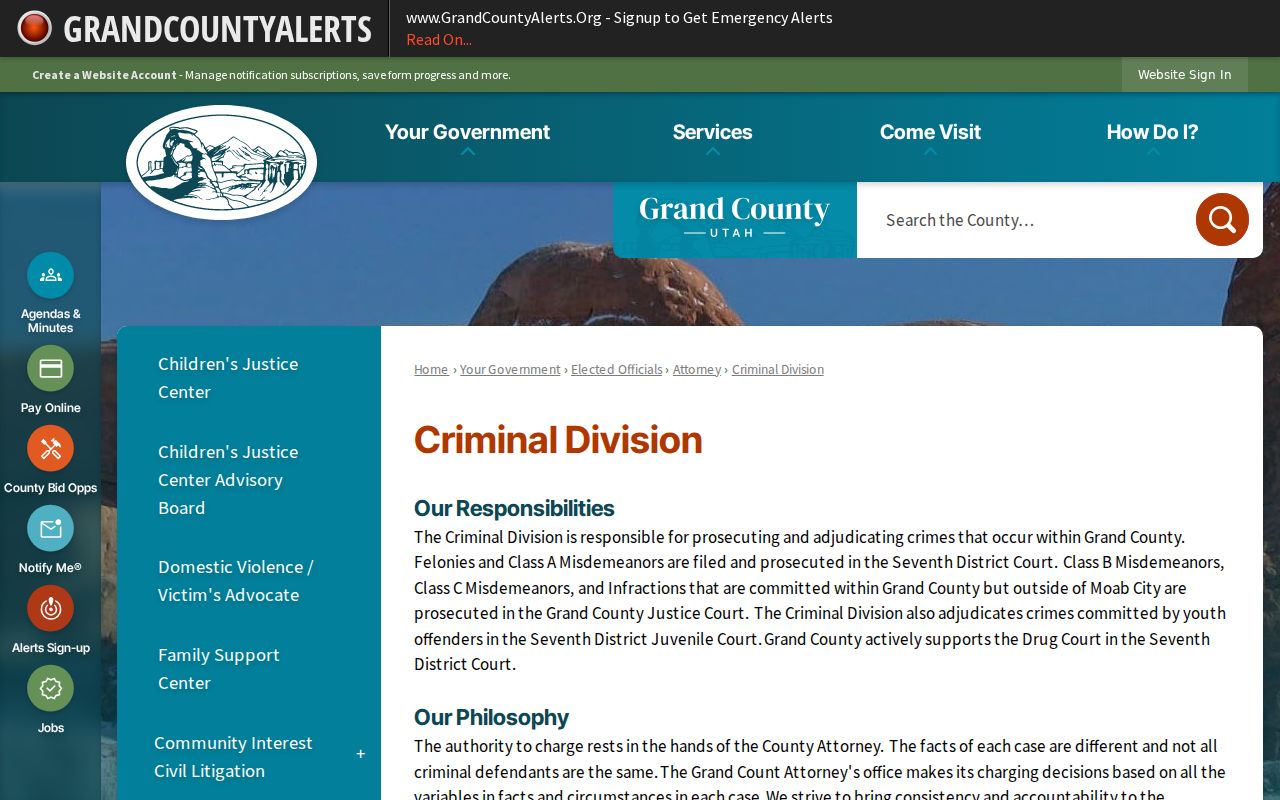
The prosecution page reinforces why a police report and a filed court case must be requested from different offices.
Find Moab Court Case Records
Utah Courts Xchange is the public statewide portal for many Moab District and Justice Court dockets. Search by an exact Moab case number when possible. For a name search, narrow with Grand County, the court location, case type, filing dates, or disposition dates. The system returns no more than the first 500 matches, so wide common-name searches can hide the useful Moab result.
Xchange reflects Moab CORIS data after clerk entry but is informational. It excludes juvenile matters, nonpublic criminal cases, sealed or expunged cases, and some older Justice Court cases from before CORIS participation. A missing result is therefore not proof that no Moab incident or older case exists. The Moab clerk remains the official record keeper and the right source for a certified disposition.
The Grand County Attorney page identifies the county prosecutor’s role in local criminal matters.
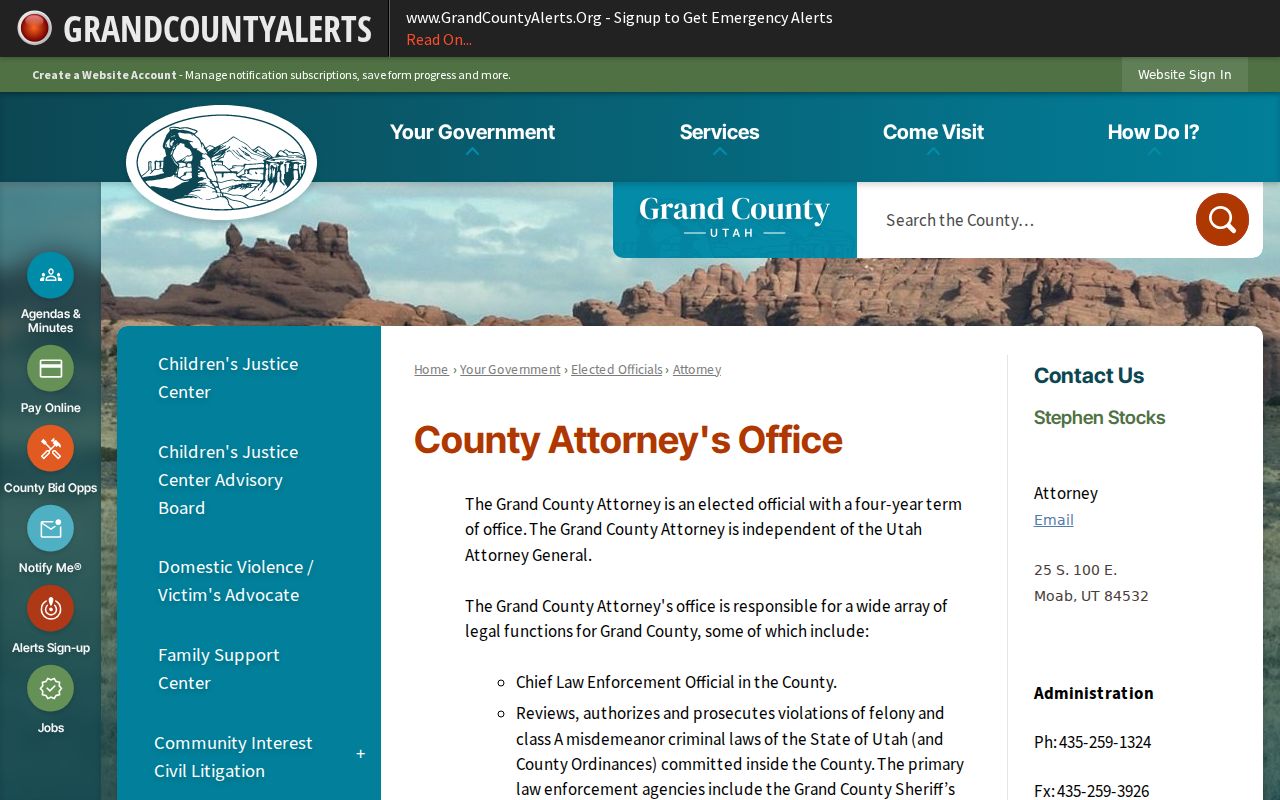
That official role page connects a Moab agency report to the later charging decision without treating the arrest allegation as the filed case.
How Moab Records Reach the County
A Moab officer first creates the incident or arrest report. If the person enters custody, Grand County Jail creates the booking file. A prosecutor then decides whether and what to charge. Only after filing does a court clerk create the docket events that appear through Xchange. Fingerprint-supported arrest data and reported outcomes can then enter BCI’s Utah Computerized Criminal History file.
Record flow: Moab Police › Grand County Jail and Courts › Utah Department of Public Safety, Bureau of Criminal Identification
The Moab flow explains why the newest source is not always the most complete. Moab police and jail files lead for a recent event. The court disposition leads for the legal outcome. A person checking their own statewide record can compare that Moab court result with the BCI Right of Access response and challenge a mismatch through the agency that holds it.
When Moab Fingerprints Are Unavailable
BCI Right of Access requires an official fingerprint block or a ten-print card, along with valid identification. Utah’s law-enforcement fingerprint-site list had named Moab Police for limited appointment hours, but a September 2025 service notice marked the equipment unavailable. The research did not establish that service had resumed. Call 435-259-8938 before planning a visit.
The Utah fingerprint service list is the current source for sites and service notices.
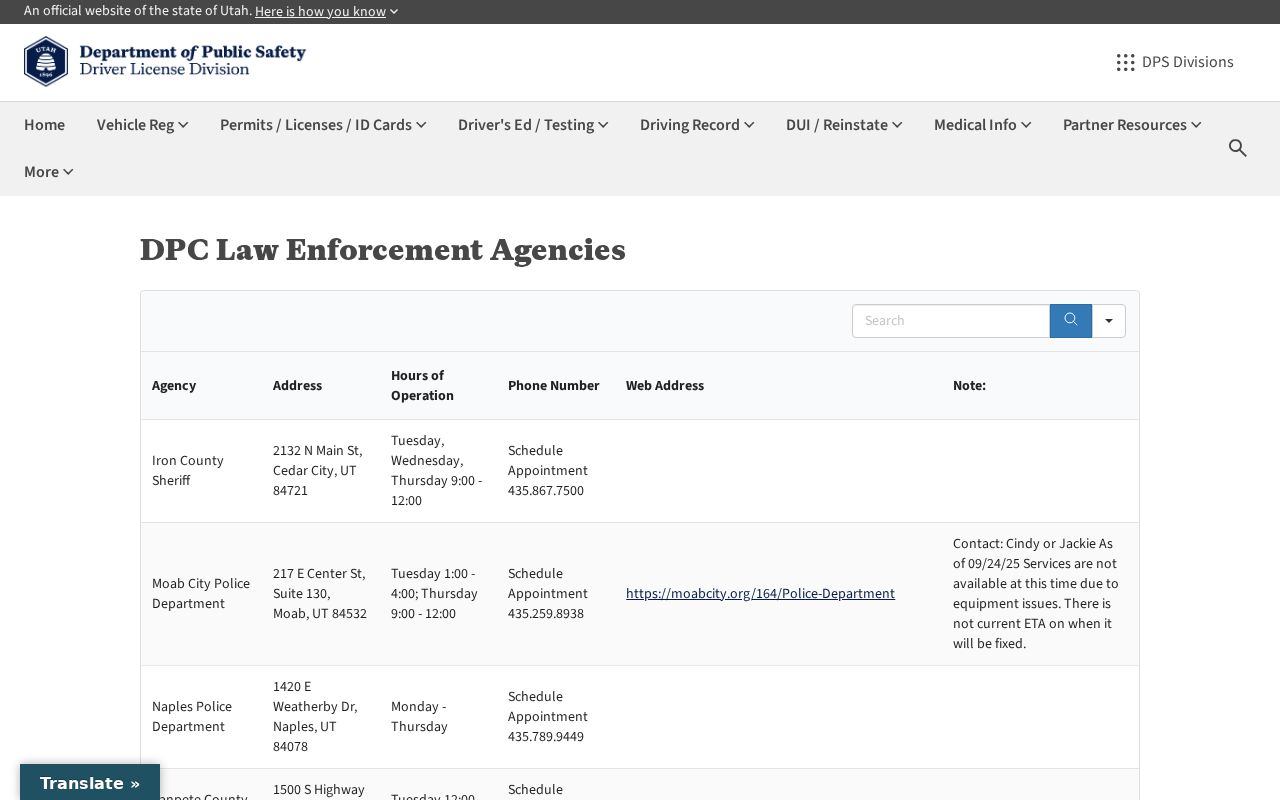
If Moab service remains down, use another BCI-approved public agency or BCI in Taylorsville after calling ahead. Do not submit an ordinary police report request as a substitute for the fingerprint-supported self-record process.
Moab Record Access Rules
GRAMA provides a Moab request procedure, not a promise that every Moab police file is open. A Moab request may be narrowed, redacted, or denied when it reaches private, protected, controlled, juvenile, victim-identifying, or active-investigation material. Moab court records follow judicial classification rules, while BCI dissemination follows a separate criminal-history statute. Ask a denial to state the classification and appeal route.
Key Statutes:
Utah Government Records Access and Management Act - Section 63G-2-202 governs requests and proof of a right to nonpublic records.
Utah Code §53-10-108 - BCI dissemination is limited, while a person may review and challenge their own record.
Utah court-record classifications - Public Xchange omits private, sealed, expunged, juvenile, and other nonpublic matters.