
Criminal Court Cases in Grand County
Grand County criminal court cases divide by charge class. The Seventh Judicial District Court hears felonies and class A misdemeanors. Grand County Justice Court hears class B and C misdemeanors, infractions, and lower county matters arising outside Moab. Juvenile delinquency goes to the Seventh District Juvenile Court and is not part of the public Xchange index. All three courts operate from the county complex at 125 E. Center Street in Moab, but each clerk controls a distinct set of files.
The prosecutor's review can change the route. The Grand County Attorney Criminal Division reviews felonies and class A misdemeanors countywide, as well as lower county offenses outside Moab. An offense named at booking may be declined, amended, or filed under a different class. Start with the filed count, court name, and final disposition, not the intake allegation. The official Grand County Justice Court page gives the local court's current scope and contact details.
The manifest capture from that Grand County court source shows the official local information page.
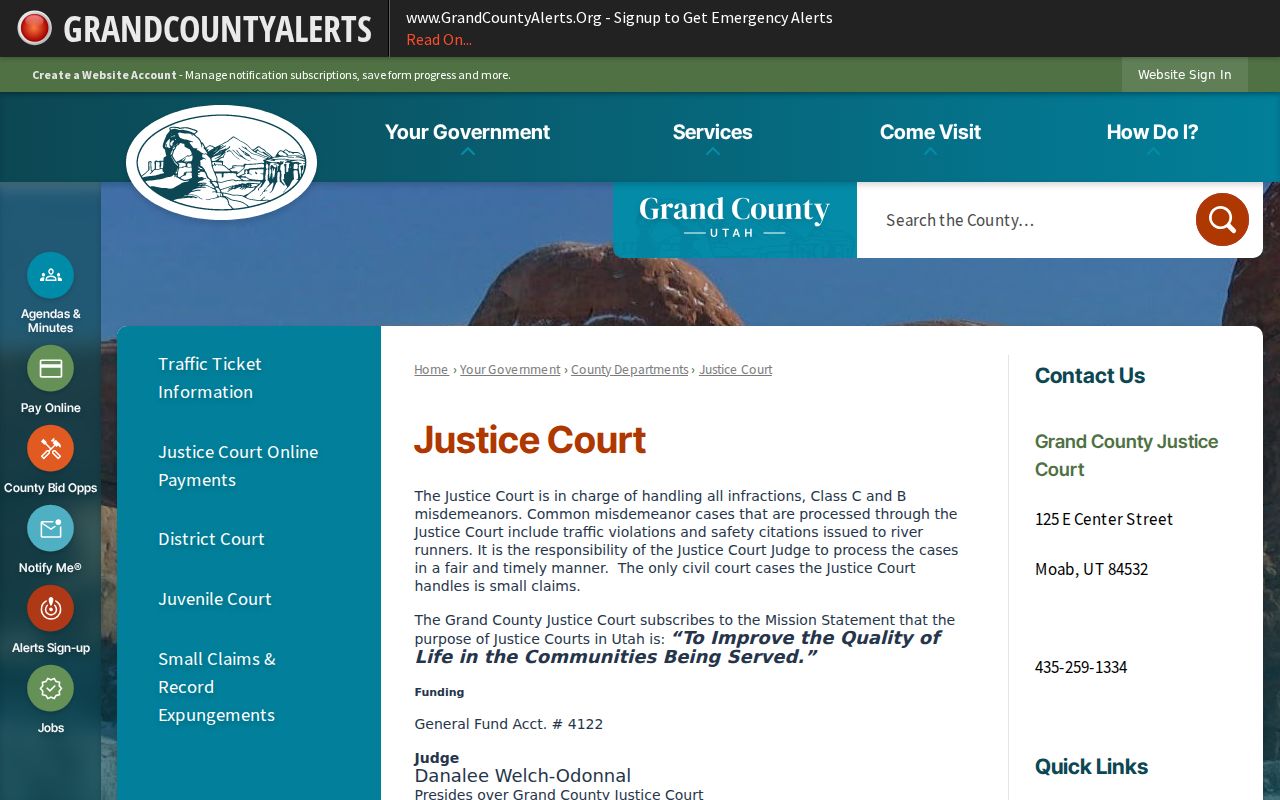
That page is the sound starting point for lower county charges, while felony and class A files remain with the District Court clerk.
Two Grand County Criminal Courts
Moab's shared courthouse can trip up a person who arrives at the right address but approaches the wrong counter. The county-owned complex holds District, Juvenile, and Justice courts and has two courtrooms. The smaller second courtroom commonly serves Justice Court work. The arrangement is useful in a rural county, yet it does not merge the records. A District Court clerk cannot turn a sheriff incident narrative into a court filing, and the county Clerk/Auditor is not the custodian of a criminal docket.
Use the case caption or number to confirm the court before requesting a copy. The Utah Courts Grand County contact page lists the Seventh District courthouse at 125 E. Center Street, Moab, UT 84532, with a court contact number of 435-259-1349. Justice Court lists 435-259-1334 and jcmoab@utcourts.gov. The Grand County government directory helps route county-office questions. Court calendars and holidays affect counter access, so call before a trip.
The Seventh District courthouse source also supplied the following Grand County image.
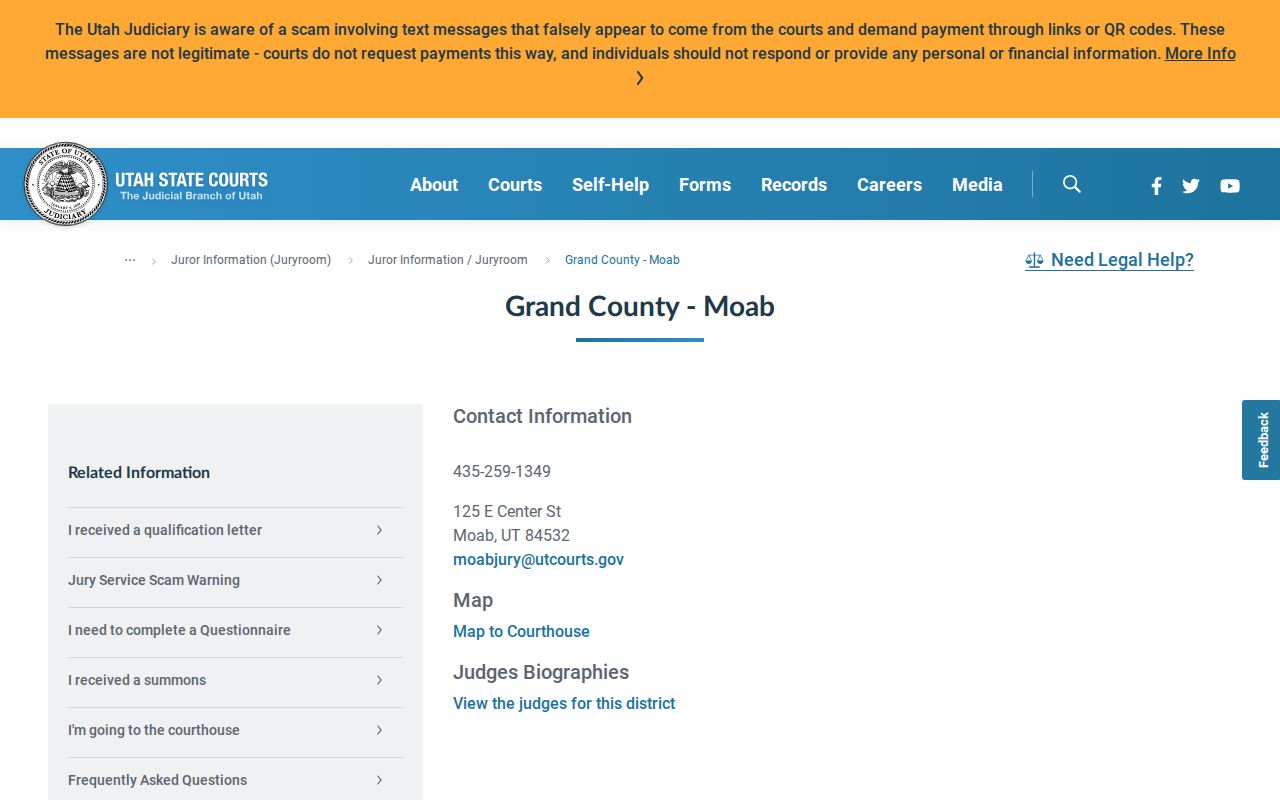
It helps distinguish the state court contact from the county Justice Court desk at the same civic address.
Grand County Case Record Searches
Utah Courts Xchange Case Search is the main public route for Grand County criminal case records entered in CORIS, the courts' case information system. A guest can choose the guest and pay-now path, while frequent users may use an account. Search an exact case number when possible. A name search works best when narrowed to Grand County, the Moab court location, a criminal case type, and a filing or disposition range. A party may also use free MyCourtCase for many of their own Grand County cases.
- Open Xchange and choose guest access with pay now, or sign in to an account.
- Enter the exact case number, or use a party name as the main search parameter.
- Narrow a name result by Grand County, court location, case type, and useful date ranges.
- Open the summary and chronological docket, then read each charge and outcome on its own.
- Ask the proper clerk for an official or certified copy when the record must be authoritative.
| Field label | Type | Required | Use in a Grand County search |
|---|---|---|---|
| Name or party | Text | One parameter | A blank middle name also returns middle-name and initial variants. |
| Case number | Text | Alternative | Use the exact court case number when known. |
| County | Filter | No | Select Grand County to reduce unrelated names. |
| Court location | Filter | No | Choose Moab District or Grand County Justice Court. |
| Case type | Filter | No | Limit results to the relevant criminal category. |
| Filing or disposition dates | Date range | No | Use dates to narrow common names and large result sets. |
The official Xchange entry screen is shown in the assigned capture.
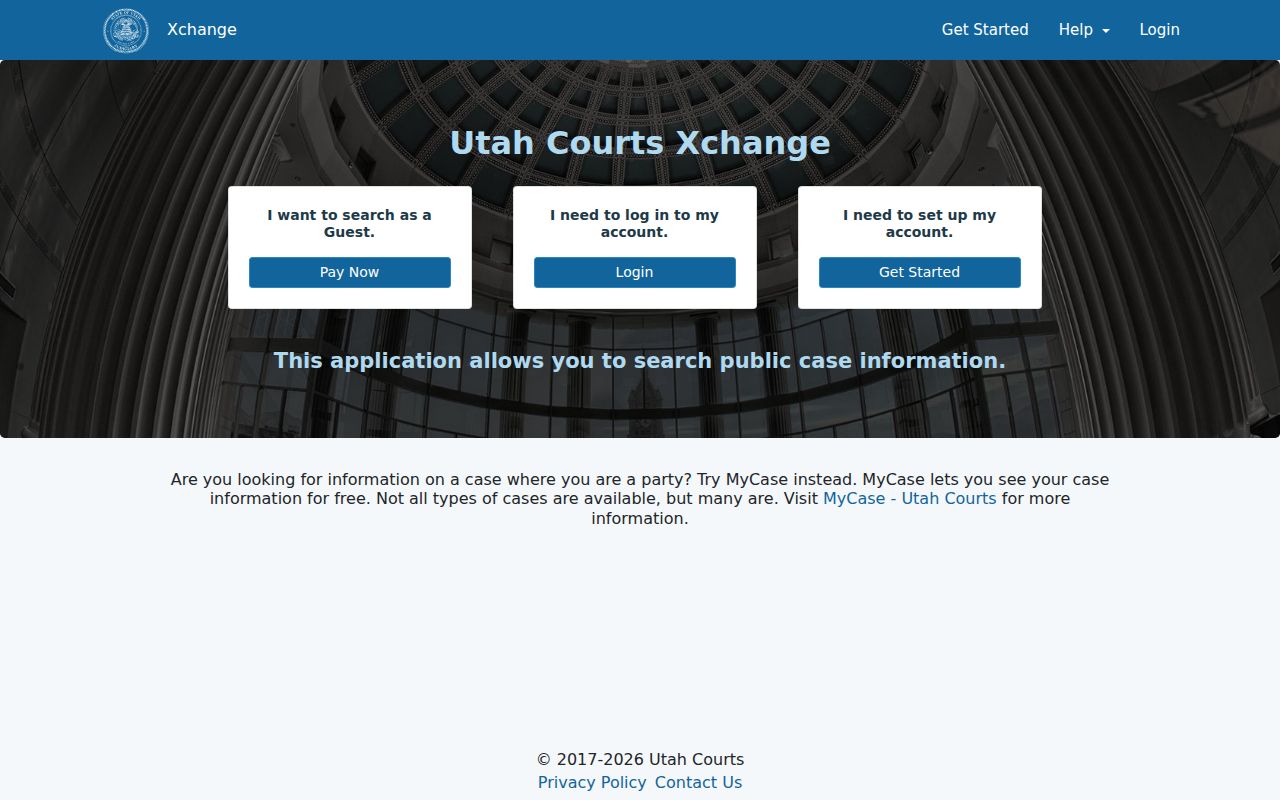
The screen is an access point to court data, while the clerk remains the official record keeper.
Narrow Grand County Case Results
Xchange returns no more than the first 500 matches. A broad name can therefore hide the useful Grand County court case outside the visible set. Add the county, court location, criminal case type, filing dates, or disposition dates. An exact case number is better still. The portal's name logic also matters: leaving the middle-name field blank can return the base name along with middle-name and middle-initial variants.
Older Justice Court records may be absent if they predate that court's participation in CORIS. Sealed, expunged, juvenile, and specified nonpublic criminal matters are excluded by design. Those gaps do not prove no case existed. Call the Justice Court clerk about an older lower-court file, or the District Court clerk about a felony or class A matter. The official Xchange FAQ explains the coverage, exclusions, limit, and correction route.
The assigned Xchange scope source highlights why a careful filter matters.
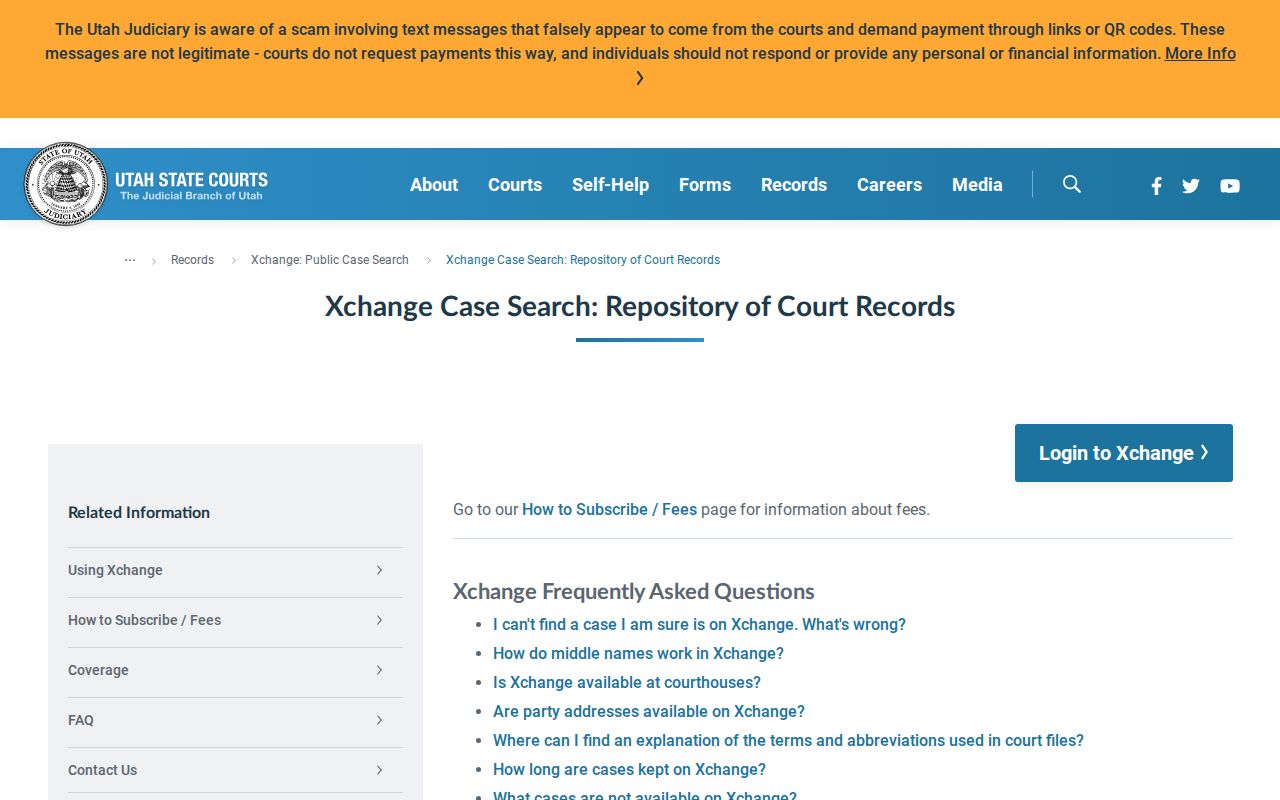
Its limits support a clerk follow-up whenever the online result is incomplete or appears wrong.
Note: A blank public search may reflect access rules, date coverage, or a broad query rather than the absence of a case.
What a Criminal Case File Contains
A Grand County criminal case file follows the prosecution, not the full police investigation. The docket may identify the case, court, parties, attorneys, filed counts, hearing dates, motions, orders, disposition, judgment, sentence, and some financial entries. Public party addresses may appear through a party-name link, but protected identifiers are not ordinary public fields. Some documents can be opened online. The useful proof of outcome is the final order or certified disposition from the clerk, read charge by charge.
| Case header | Case number, type, filing court, filing date, status, and location. |
|---|---|
| Parties | Prosecuting entity, defendant, and listed attorneys, subject to public-access rules. |
| Charges | Each filed count, its degree or class, disposition, and disposition date. |
| Docket events | Filings, appearances, pleas, hearings, motions, orders, warrants, and judgment entries when public. |
| Hearings | Scheduled date, time, type, and judicial officer when the public view supplies them. |
| Documents and money | Available filed documents and some assessment or payment details, depending on access. |
| Final outcome | Disposition, judgment, sentence, and conditions as recorded by the court. |
The Grand County court file should be matched to the correct person and case number. Similar names alone are weak proof, and one case can contain several counts with different results.
Grand County Xchange Documents
Xchange offers guest and subscription paths, and each search parameter is billable under the posted schedule. Some case documents carry a $1 document-access charge. Buying a document gives access to what the portal makes available; it does not turn a screen image into a certified court record. Use the clerk for authentication, a certified disposition, or correction of an inaccurate entry.
The assigned image comes from Utah Courts' Xchange fees and subscriptions page.
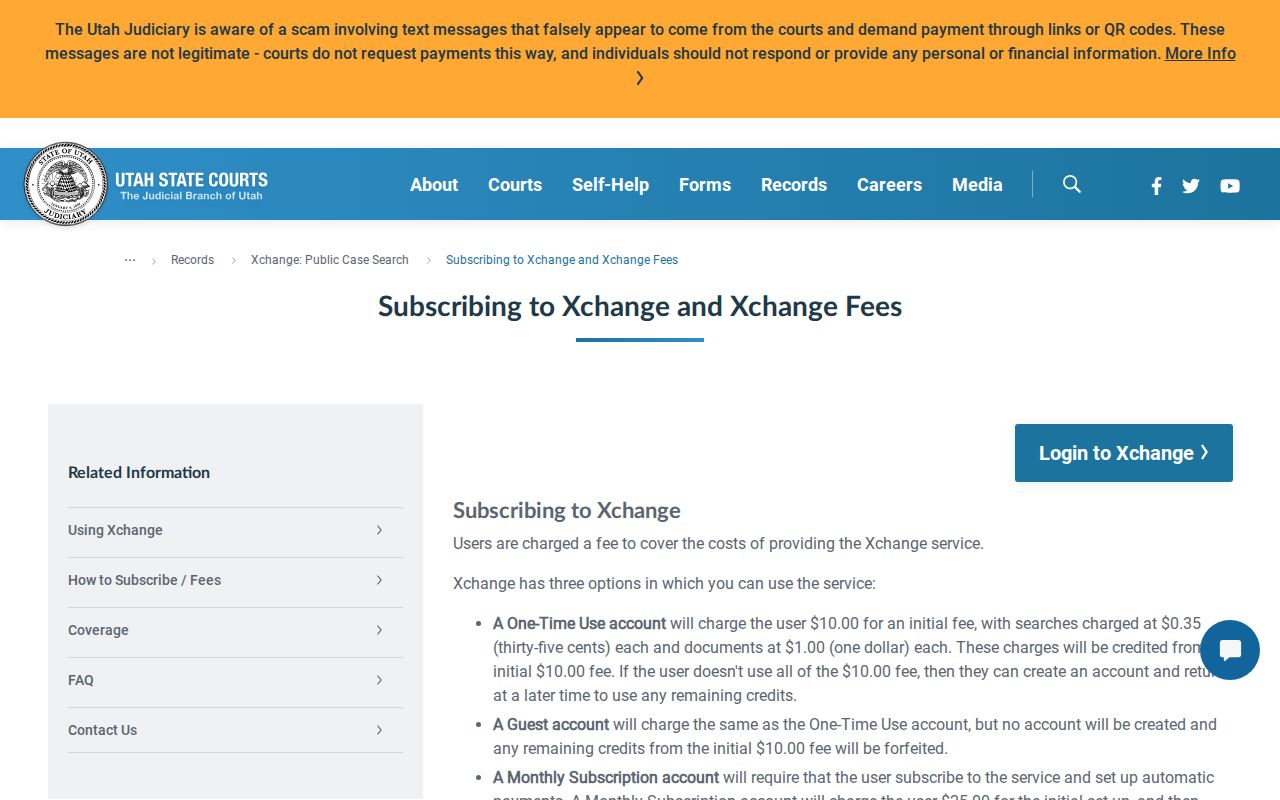
It separates the cost of portal access from the clerk service needed for an official certified result.
Criminal Case Stages in Grand County
A Grand County criminal case begins in court only after a prosecutor files charges. The clerk then records events in CORIS, and public entries feed Xchange after entry. At arraignment, the filed charges are addressed and a plea is taken. Pretrial work may include discovery, motions, negotiations, and hearings. A case may end by dismissal, plea, acquittal, or conviction after trial. If there is a conviction, judgment and sentencing follow. Later orders can address payment, probation, appeal, or expungement.
Case flow: Charges Filed › Arraignment › Pretrial › Plea or Trial › Disposition › Sentencing
An arrest and booking can occur before that flow, but neither decides what the court will file or how each count will end. The separate Grand County arrest search explains the agency and jail records that precede the court docket.
Read Grand County Charges by Count
Each count is one separately alleged offense. Read the charge description, degree, disposition, and date on the same row or linked event. A dismissal ends that count without a conviction. An acquittal is a not-guilty result after trial. A conviction means guilt was established by plea or verdict and judgment. A plea in abeyance is a Utah agreement that holds a plea while stated terms are completed; its effect depends on the governing law and the final outcome.
- Docket
- The chronological record of filings, hearings, rulings, and other court events.
- Disposition
- The result recorded for a count or for the case.
- Judgment
- The court's formal determination entered after the case result.
- Sentence
- The court-imposed consequence following a conviction.
- Bench warrant
- A court-issued warrant that can follow a failure to appear or comply.
The booking charge and filed charge need not match. The prosecutor makes an independent filing choice, and later amendment or plea work may change the count again. A reliable Grand County criminal case reading therefore ends with the final disposition, not the first allegation.
Certify a Grand County Case Outcome
When an online Grand County summary is not enough, contact the clerk of the court named on the docket. Give the exact case number, party name, and the document sought. Ask whether the office can supply a certified disposition, judgment, or other filed order. District Court handles felony and class A files. Justice Court handles its lower county docket. The shared address makes Grand County court identification more important, not less.
Seventh District Court
125 E. Center St.
Moab, UT 84532
435-259-1349
Grand County Justice Court
125 E. Center St.
Moab, UT 84532
435-259-1334
jcmoab@utcourts.gov
The Grand County clerk also corrects the official court entry when documentation shows an error. Public Xchange terminals exist at many Utah district courthouses, but call the Grand County clerk in Moab to confirm local availability and hours before travel. A screenshot, third-party summary, or jail charge list cannot serve that function.
Access Rules for Case Records
Utah court records follow judicial access rules rather than the county's general records portal. Public Xchange omits juvenile cases, sealed and expunged cases, specified private criminal matters, and protected data. Public absence is expected in those categories. A victim's identity, a minor's information, and protected personal identifiers may also be withheld or redacted. Court restrictions do not mean every related agency record has the same status, since the police report, jail booking, docket, and BCI history have different custodians.
Expungement seals qualifying Grand County government records. As of January 1, 2026, Utah Courts identifies qualifying automatic cases without a defendant application. Petition-based relief still depends on the outcome, offense, waiting rules, completed sentence, and other requirements. File through the court that handled the Grand County case and keep certified copies of an order.
The assigned image links to Utah Courts' current expungement instructions.
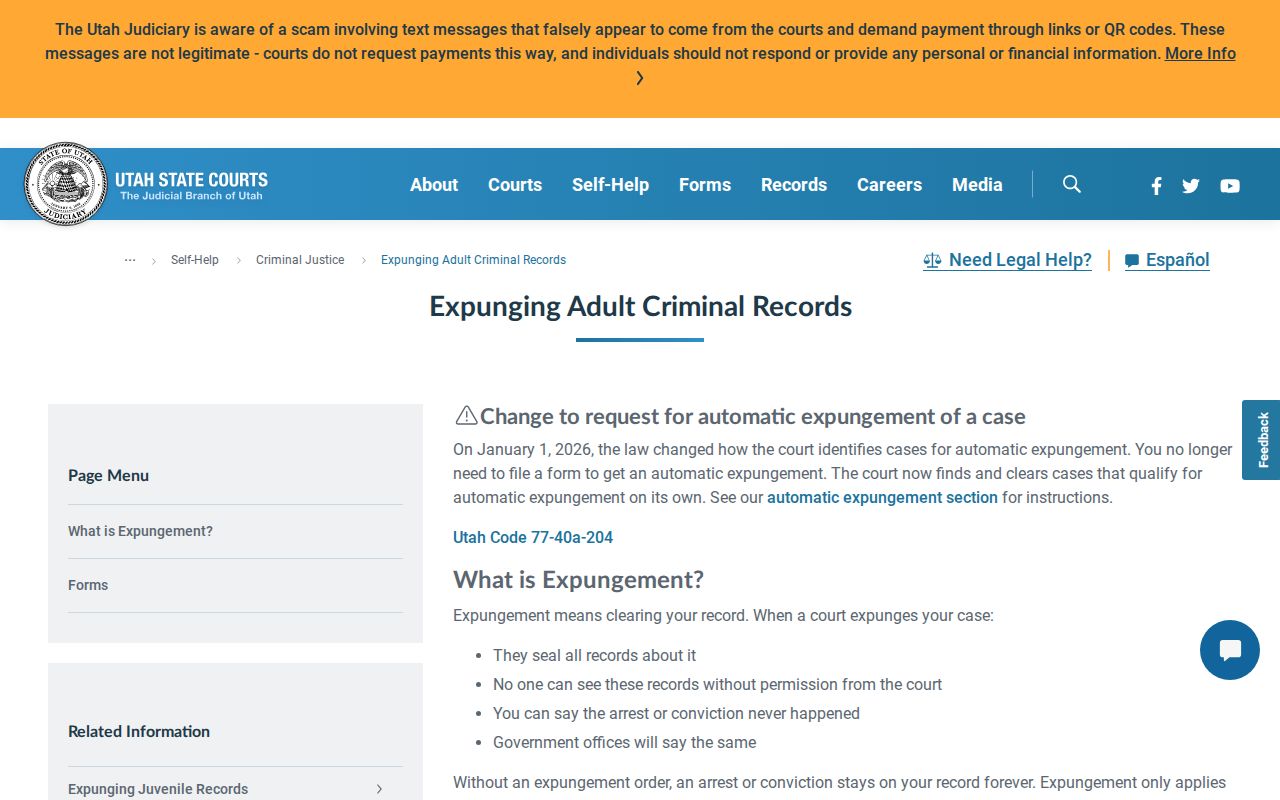
Those instructions explain why an expunged Grand County case can lawfully disappear from the ordinary public search.
Note: Xchange is informational; the appropriate Grand County court clerk keeps the official file and handles certified copies or corrections.